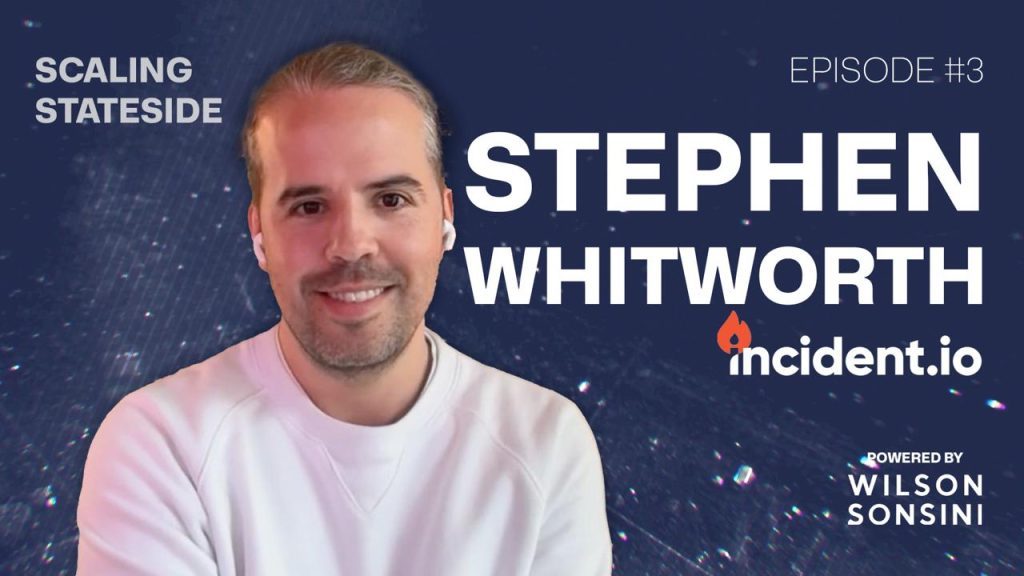
In the latest episode of Scaling Stateside, we sat down with Stephen Whitworth, CEO and co-founder of Incident.io, to explore his remarkable journey from a paper boy in the UK to leading a successful incident response platform serving tech giants like Netflix and Airbnb. Stephen’s candid conversation with hosts David Rose and Matt Oxley revealed the real challenges, tough decisions, and personal sacrifices involved in scaling a UK startup into the US market.
The Entrepreneurial Spark
Stephen’s path to entrepreneurship wasn’t a straight line. Starting with a business management degree and a series of odd jobs including being a paper boy, his career took a pivotal turn at Code Academy—the moment that transformed him from business graduate to software engineer. This technical foundation would prove invaluable as he navigated the Silicon Roundabout era, landing his first tech job at Halo before co-founding Ravelin, a fraud detection company.
But it was Incident.io, launched as a side hustle in January 2021, that would become his most ambitious venture yet. The timing and the problem space were perfect: software breaks everywhere, and incident response is a universal challenge that transcends borders.
When the US Market Pulls You In
What made Incident.io’s US expansion story particularly compelling is that it wasn’t a forced push—it was an organic pull. “We found that two-thirds to three-quarters of our early customers came from the US,” Stephen explained. This market validation became impossible to ignore.
The decision to expand wasn’t made lightly. Stephen and his team evaluated multiple factors: verified market demand, competitive positioning, and long-term vision. Unlike many founders who view US expansion as a nice-to-have, Stephen recognized it as essential for winning in the competitive incident response space.
The company initially chose New York as their US base before later switching to San Francisco—a lesson learned about the importance of being in the right tech ecosystem for B2B software. With a team of about 30 people, they committed to building dual headquarters from day one, signaling serious intent to both US customers and investors.
The CEO’s Personal Commitment
Perhaps the most significant aspect of Incident.io’s expansion was Stephen’s decision to personally relocate to the US. As CEO, his physical presence sent a clear message: this wasn’t a tentative test—it was a full commitment.
But this commitment came with real costs. Stephen spoke openly about the human challenges of expansion: the disruption of daily routines by time zone differences, the separation from family, the guilt over constant travel, and the unexpected isolation of building a business in a new country. “Hiring employees is very different from making friends,” he noted, highlighting a challenge many relocated founders face but few discuss publicly.
Coming from a multicultural background (born in Singapore with a Canadian mother), Stephen was more comfortable with international moves than many. Yet even for him, the adjustment was significant. The work-life balance shifted dramatically, relationships were tested, and the familiar support systems of home were suddenly thousands of miles away.
Navigating Cultural Differences
Beyond the personal challenges, Stephen had to adapt to fundamental differences in how business is conducted across the Atlantic. US hiring practices, interview styles, and communication norms all required recalibration. He observed that Americans tend to present themselves with more polish and confidence, while UK professionals often embrace vulnerability and authenticity—neither approach is wrong, but understanding these differences is crucial for building effective transatlantic teams.
Even seemingly simple things like sports culture became unexpected challenges. Building relationships in the US often involves sports conversations that don’t translate directly from the UK. As Stephen admitted with good humor, he still doesn’t understand college football—but he’s learned that acknowledging these gaps authentically often works better than pretending.
Lessons for European Founders
Stephen’s journey offers several key insights for European founders considering US expansion:
Follow the Pull, Not Just the Plan: Incident.io’s expansion was driven by actual customer demand, not just ambition. When US customers are actively seeking you out, that’s a powerful signal.
CEO Commitment Matters: Personal relocation by the founder sends an unmistakable message to customers, investors, and team members about your commitment to the market.
Be Honest About Trade-offs: US expansion will disrupt your life. Acknowledging these challenges openly—with your team, your family, and yourself—is essential for sustainable growth.
Location Still Matters: Even in a remote-work era, being in the right tech hub (like San Francisco for B2B software) provides access to talent, customers, and networks that can’t be easily replicated remotely.
Cultural Adaptation is Real Work: Don’t underestimate the effort required to understand and adapt to American business culture while maintaining your authentic leadership style.
The Bigger Picture
Stephen’s story reinforces a central theme of Scaling Stateside: successful US expansion requires full commitment, not half-measures. The US market rewards those who are willing to fully engage with its unique dynamics, build genuine presence, and navigate both the business and personal challenges that come with international growth.
For Incident.io, that commitment is paying off. By recognizing early market signals, making bold leadership decisions, and staying authentic while adapting, Stephen and his team have built a genuinely transatlantic company serving some of the world’s most demanding technology customers.
The path wasn’t easy, and Stephen didn’t sugarcoat the challenges. But for founders with genuine product-market fit and the willingness to commit fully, his journey demonstrates that scaling stateside can be transformative—both for your business and for you personally.
Ready to explore your US expansion journey? The team at USXP helps European tech scaleups navigate the entire lifecycle from readiness through launch to revenue. Connect with us to discuss your path stateside.
Listen to the full conversation with Stephen Whitworth on the Scaling Stateside podcast on YouTube, or wherever you get your podcasts.