Let me paint a picture that might sound familiar.
You have a handful of promising meetings with US VCs. The conversations go well. There is genuine interest. You leave energised. And then… nothing. Weeks pass. You send a follow-up. Maybe you get a polite reply. But the momentum you felt in that room has quietly evaporated, and you are not entirely sure why.
Here is one reason that does not get talked about enough: US venture capital partners are drowning in deal flow. A partner at a top-tier fund might receive hundreds of inbound pitches, emails, and introductions every single week. The founder who had a good first meeting six weeks ago is, through no fault of their own, competing for mindshare against an avalanche of new opportunities every single day.
This is not a reason to feel discouraged. It is a reason to be strategic. And one of the most effective strategies available to you — one that US founders use routinely and European founders almost never do — is the monthly investor newsletter.
Why This Works in the US
American startup culture has built a healthy set of norms around investor communication. Founders are expected to be proactive. Investors are accustomed to receiving regular updates from the companies they back and the companies they are watching. It is a form of professional respect: you value their time enough to keep them informed without requiring them to chase you for a status update.
What surprises most European founders is how far this expectation extends beyond existing investors. Prospective investors — people who have not yet written you a check — also welcome being added to a thoughtful founder’s update list. Over the course of my career across multiple ventures, I found that when I asked investors at the end of a first meeting whether they would like to receive my monthly investor newsletter, the answer was almost always yes.
Think about what that means. Every investor meeting you take is an opportunity to stay on that person’s radar indefinitely, at no cost and very little effort. Most founders walk out of those meetings and send one follow-up email. The best ones keep showing up in that investor’s inbox every month, month after month, building a quiet track record of momentum.
Build the List the Right Way
Two audiences belong on your investor newsletter list: your existing investors, and the prospective investors you are actively cultivating.
Existing investors appreciate this more than most founders expect. Nobody on your cap table enjoys having to reach out and ask how things are going. A monthly update removes that friction entirely and shows that you operate with transparency as a default, not just when things are going well.
For prospective investors, the rule is simple: ask every time, but only with permission. I make it a habit at the end of every investor conversation — whether it is a formal pitch or a casual coffee — to ask if they would like to receive my monthly update. Almost everyone says yes. And critically, I never add anyone without asking first. Spam is the fastest way to damage a relationship before it starts. This should be treated as a proper drip campaign, built on opt-in consent from day one.
The Format That Actually Gets Read
US investors do not have time to read prose. I say that not as a criticism but as a practical reality you need to build around. The investor newsletter lives or dies by how quickly it can be scanned and understood. That means concise bullet points, real numbers, and a clear structure. Every time, without exception.
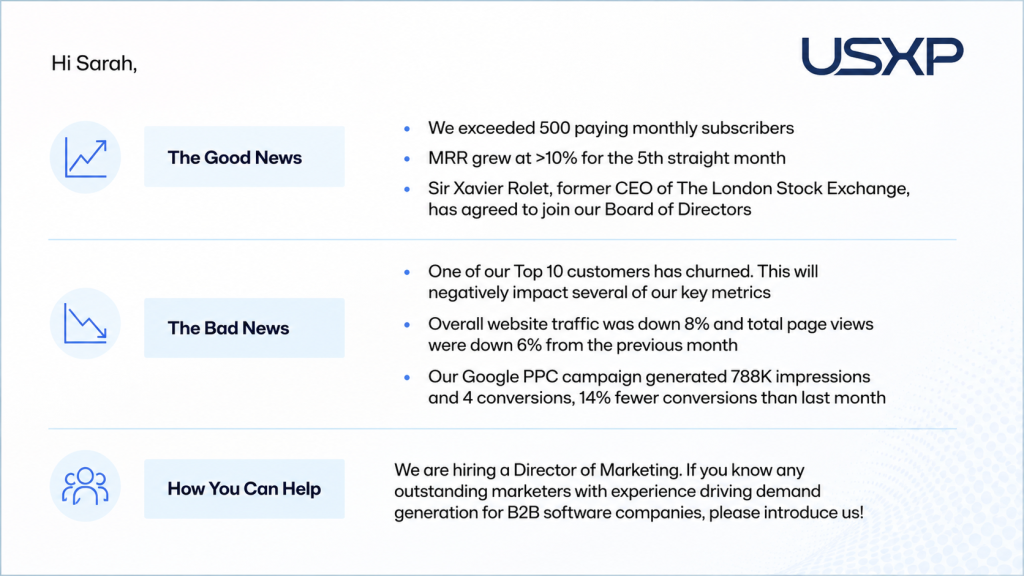
The format I developed across my own fundraising rounds has three sections, and I have not found a reason to deviate from it:
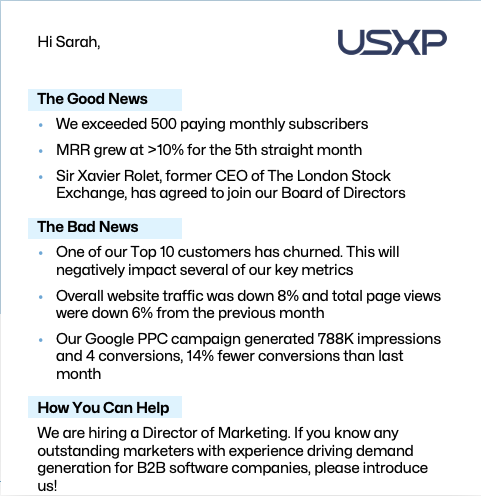
Here is what each section should look like in practice — and why each one earns its place in the update.
The Good News
Three bullet points. Specific, metric-driven wins from the past month. Revenue milestones, customer growth, product launches, key hires, strategic partnerships. If you cannot attach a number to it, reconsider whether it belongs here.
One rule I am disciplined about: only include things that have already happened. Not things you are planning, not things that are coming next month, not the beta you are about to release or the campaign you are about to launch. Experienced investors see future-tense good news for what it is — hope, not progress. Stick to completed accomplishments with real numbers behind them and your credibility stays intact.
The Bad News
This is the section that most European founders resist, and it is the one that matters most to experienced US investors.
I understand the instinct to protect the narrative. You want investors to see a company that is winning, not struggling. But here is the thing: the vast majority of US venture capital partners are former operators. They have lived through every variety of startup crisis imaginable. They know full well that things go wrong at startups every single week. If your newsletter only ever tells the positive story, experienced investors do not think you are exceptional. They think you are either not paying attention or not being straight with them.
Sharing three honest, metric-driven bullets about what is not working does the opposite of what most founders fear. It builds credibility. It demonstrates that you have a clear-eyed understanding of your business. And identifying a problem clearly is always the first step to fixing it. Some of the best conversations I have had with investors came directly from something I shared in the bad news section.
How You Can Help
This section consistently surprises founders with how much it delivers. Investors have spent careers building networks, and most are genuinely happy to make introductions, share expertise, or open doors — they just need to know specifically what you need.
Are you hiring a VP of Sales? Say so. Looking for a warm introduction to a particular company or investor? Ask for it. Need someone who has navigated a specific regulatory challenge? Put it in the newsletter. The combination of a warm relationship and a specific request is remarkably powerful. People help when they know exactly how to help.
Send It Like a Professional
Use a proper email platform — HubSpot, Mailchimp, or similar. I know it might feel like overkill for what is essentially a monthly email, but the analytics alone are worth it.
Open rates, click-through rates, forwarding behaviour — these are not just vanity metrics. They are fundraising intelligence. The partner who opens your newsletter within an hour of it landing, every single month, is signalling something meaningful. The one who has never opened a single edition is also telling you something. That information should directly inform where you invest your energy and follow-up time during an active fundraising process.
On timing: through trial and error, I found that sending very early on the last Saturday morning of the month consistently delivered my best open rates. US investors tend to be high-output, type-A individuals who check email early, even on weekends. Catching them before the weekend kicks in — before family commitments, before distractions — means your update gets real attention rather than a quick scroll.
The Discipline Is the Differentiator
Everything I have described only works if you actually do it. Monthly. Every month. Not when it is convenient, not when you have good news to share, not after a productive fundraising week. Every month, regardless of what is going on in the business.
I want to be honest about the fundraising context here. There is no shortage of funding announcements coming out of Europe at the moment, and it is easy to look at those announcements and assume that raising US venture capital is achievable with the right pitch and the right connections. For the founders who eventually close those rounds, the reality behind the scenes is typically a very different story: many months of grinding, of rejections, of building relationships from scratch in a market where nobody knows who you are yet.
That is the norm. And that is precisely why the investor newsletter matters. It is one of the most reliable blocking-and-tackling activities available to you during the long haul of a fundraising process. It keeps your name and your progress front and centre with the right people, without requiring a new pitch or a new reason to get back in touch. By the time you are ready to run a formal process, you are not starting from scratch. You are following up with people who have been watching you build for six or twelve months. That is a very different conversation.
Build the discipline now. The compounding effect is real.
Key Takeaways
- The investor newsletter is standard practice among US founders and expected by US VCs. European founders who adopt it gain a meaningful edge in building and maintaining investor relationships.
- Ask every investor you meet if they would like to receive your monthly update. Almost all will say yes. Never add anyone without explicit permission.
- Use the three-part format: The Good News, The Bad News, and How You Can Help. Three concise, metric-driven bullet points in each section.
- Sharing bad news is not a weakness. It is one of the most credibility-building things a founder can do with a sophisticated US investor audience.
- Use a professional email platform so you can track open rates, forwards, and engagement. That data is fundraising intelligence, not just analytics.
- Send early on the last Saturday morning of the month for the strongest open rates with US investors.
- Commit to the cadence. A newsletter that goes out every month for a year builds something that a great single pitch cannot: a track record of consistent, transparent leadership.