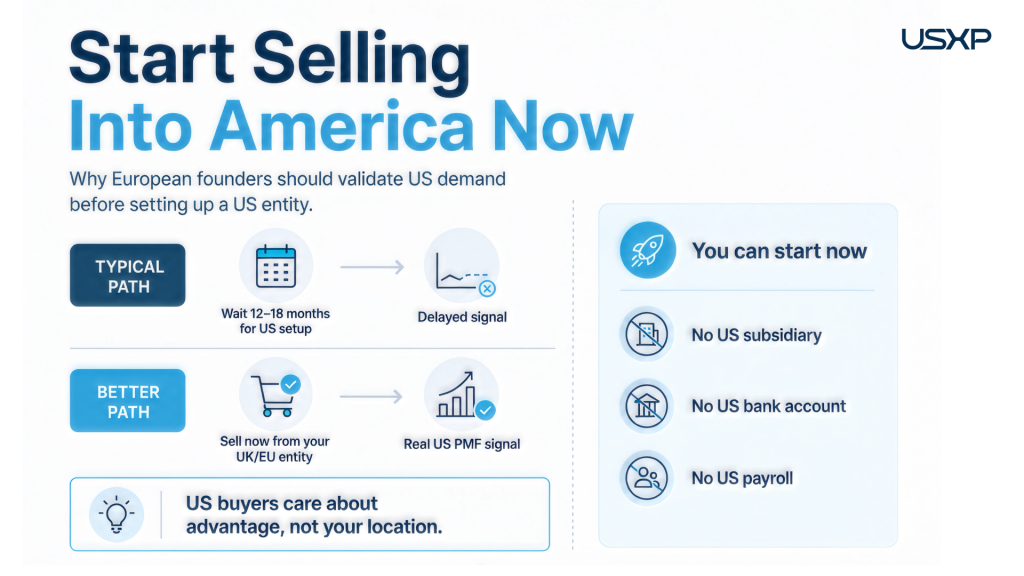
Most European founders delay US sales by 12-18 months waiting to set up a US entity. That delay is costing you the most valuable data you can get: real signal on US product-market fit.
Here’s the truth I tell every founder I work with: you can start selling into the US market today, from your existing UK or EU entity, with no US subsidiary, no US bank account, and no US payroll.
I know that sounds counterintuitive. Most founders assume American buyers won’t touch a contract with a foreign entity. In practice, that’s only true some of the time — and the exceptions matter less than you think.
US buyers care about advantage, not your location
The US business environment is relentlessly competitive. Buyers and operators are rewarded for finding an edge before their competitors do — and that makes them surprisingly open to new vendors, including ones based overseas.
If your product gives a US company a real competitive advantage, or makes the person buying it look good internally, plenty of them will sign with a foreign entity. Not all. But many more than founders assume.
Selling early is how you find US product-market fit
Your product-market fit in the US will not look like your product-market fit at home. Different buyers, different budget cycles, different objections, different competitive sets. That’s true almost without exception.
Selling directly into the US, before you’ve spent a dollar on a subsidiary, is the cheapest way to find out what’s different. You’ll adjust your product, your messaging, and your go-to-market — while the cost of being wrong is a few sales calls, not a fully staffed US office.
This only works if you, the founder, show up
This isn’t a job for a hired VP of Sales or a contracted SDR team. Only the founder can sit across from US buyers, absorb the real objections, and translate that into product and positioning changes fast enough to matter.
Get on planes. Take the sales calls yourself. Show up at the industry events where your buyers already are. There’s no substitute for founder-led discovery in a market this different from home.
Run US demand gen and US hours from Europe
You don’t need US-based staff to operate on US time. Run demand generation campaigns targeting US buyers directly from Europe, and shift part of your sales team’s hours to overlap with US business hours. A 2pm-10pm rotation for a few reps covers the full US East Coast day.
Pick a region. The US is not one market.
Founders chronically underestimate the size and regional fragmentation of the US. It is not one homogenous market — it’s closer to several distinct economies sharing a currency and a language.
Pick one region for your first push. The Northeast corridor — New York and Boston — is a strong starting point for most B2B tech: dense buyer concentration, manageable travel, overlapping time zones with Europe.
Flying from New York to San Francisco for a single sales meeting is expensive and slow, and it will wreck your travel economics before you’ve proven the model. Go deep in one region before you go wide.
Getting started: a quick checklist
- Pick your beachhead region. Start with the Northeast corridor unless your buyer base says otherwise.
- Localize your message for a US buyer. Use US spelling and US-native framing — small details that signal you understand the market.
- Shift sales hours to overlap with the US. Even a partial overlap dramatically improves response rates.
- Get on a plane. Book founder-led sales calls and one industry event in your target region this quarter.
- Track what’s different. Write down every US-specific objection and adjust your pitch before your next call.
Where the US entity actually comes in
None of this means you’ll never need a US subsidiary. To scale in the US, you eventually will: a US corporation to receive customer payments through US banks, meet insurance requirements your larger buyers expect, and contract the way US companies contract with each other. Winning market share at scale means operating like a US company in market.
But that’s a scaling decision, not a starting decision. Don’t let entity setup be the reason you haven’t made a single US sale yet.
If you’re planning to win market share in the US, the best time to start is now — not after the legal structure is in place.