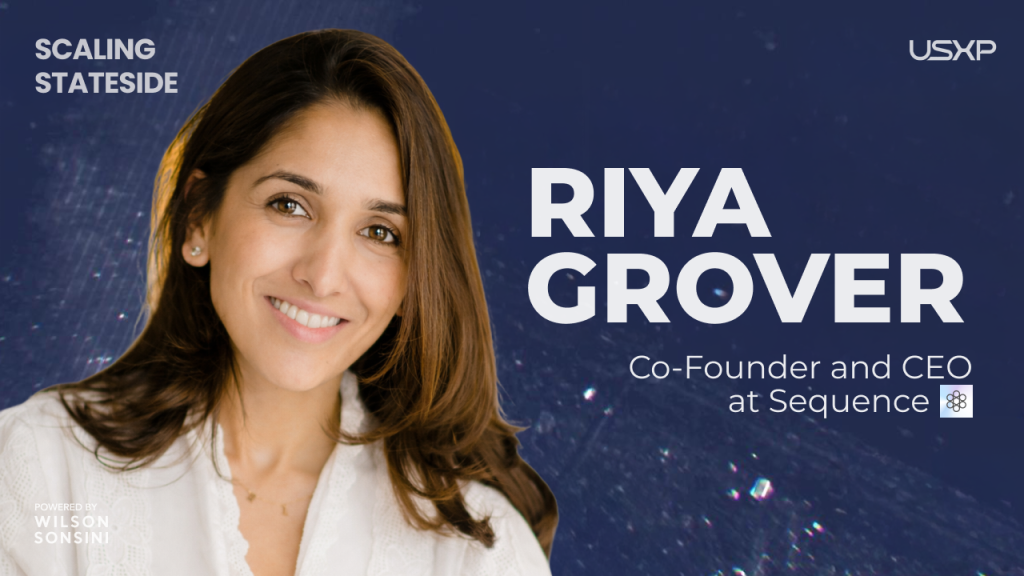
Scaling Stateside Podcast | Guest: Riya Grover, Co-Founder & CEO, Sequence
What does it actually take for a UK-founded B2B SaaS company to break into the US market and win? For Riya Grover, Co-Founder and CEO of Sequence — a finance automation platform helping CFOs modernise their order-to-cash processes — the answer involved a Harvard MBA, a pivotal conversation with Andreessen Horowitz, and a ruthless commitment to intentional market investment. Today, 60-70% of Sequence’s revenue comes from the US.
In this episode of Scaling Stateside, David Rose and Matt Oxley sat down with Riya to unpack the key decisions that got her there. Here’s what every European founder should take away.
The Background: From Oxford to Harvard to Founder
Riya grew up in an entrepreneurial household — both parents were founders, and she was helping with the business from her early teens. After Oxford, she went into investment banking, realised quickly it wasn’t where she wanted to build her career, and made the decision to pursue an MBA at Harvard Business School. That’s where she fell into tech and software, and the direction stuck.
Feeda: The First Exit
Post-MBA, Riya co-founded Feeda — a two-sided marketplace connecting independent restaurants with spare kitchen capacity to corporate and venue demand. It scaled to thousands of restaurant partners across four markets and was acquired four to five years later.
The most instructive part of the Feeda story is a pivot that wasn’t planned. To manage marketplace complexity, the team built a software stack to handle orders, payments, and loyalty — then started selling it standalone to other food service chains. When the acquisition happened, that software IP was central to the deal. It’s a pattern Riya describes as common in startups: you uncover a more valuable direction by actually operating in the market, not by planning for it upfront.
Feeda never entered the US. It was a locally-dense business where European expansion was the natural path. The US chapter would come with Sequence.
Sequence: Built Around a Problem She’d Lived
Riya launched Sequence in 2022 after a post-exit earn-out period. The problem was one she’d experienced firsthand at Feeda: B2B companies with custom pricing struggle to automate their billing and cash collection. Stripe was built for PLG checkout flows. Traditional subscription tools assumed simple annual recurring contracts. Neither worked for how modern software and fintech companies actually sell.
Sequence fills that gap with flexible billing infrastructure and, now, AI-native workflow automation across the entire order-to-cash process. The interesting design challenge: finance is a domain where AI agents can take on significant workload, but everything has to be 100% right, every time. That constraint has pushed Sequence to develop human-in-the-loop frameworks that Riya believes put them at the frontier of enterprise AI workflow design.
Landing A16Z: What It Actually Took
Sequence set out to raise its seed from top-tier UK funds. A16Z came into the conversation late — and at that point, had done very few European investments. Riya and her co-founder took the call anyway.
One hour turned into three. A follow-up session ran five or six hours on a Saturday. The A16Z team flew to London on Sunday. The deal happened because the fit was genuine, not engineered. Two things likely helped: both founders were repeat founders with exits — which carries real weight in those conversations — and they already had competitive interest from other top-tier UK funds, which signals market validation.
The downstream impact was immediate. A16Z opened doors to US customer introductions from day one, giving Sequence a commercial foothold in the US before they’d made a single US hire.
Watch the full episode on YouTube below to hear Riya tell this story in her own words, including how the A16Z conversation unfolded.
US vs. UK VCs: A Real Difference in Mindset
Having raised from both sides of the Atlantic, Riya’s contrast is worth understanding before you start pitching US funds. US VCs are less focused on early-stage proof points and much more focused on three things: is the market big enough to produce a category leader, is this the team to build it, and is the vision large enough to justify the risk. UK and European VCs tend to weight revenue, efficiency, and sensible outcome multiples more heavily.
One consequence founders often miss: if you take US VC money early, you may price yourself out of the European VC market by Series B or C. US investors will have bid valuations to a level most European funds won’t follow. That’s a strategic decision, not an accidental one.
Building a US Presence: You Have to Mean It
Sequence’s early US revenue came organically — investor introductions, Harvard connections, a software product that was largely geography-agnostic. But six to nine months in, the team recognised something important: being open to US customers is not the same as winning in the US market.
The US is more competitive, the prize goes to category leaders, and when Sequence started operating there they counted 10-12 players going after the same problem. Not wanting to be player nine or ten, they made a set of deliberate choices: New York became the US HQ, the first go-to-market hires were made in the US (not the UK), a co-founder relocated to New York to lead operations there, and the London team was embedded in US hiring to keep culture consistent across both offices.
That cultural consistency matters more than founders expect. Riya filtered for high ownership mindset, speed, and ambition from day one — and that culture translated directly when they started hiring in the US. Uniformity between offices isn’t a nice-to-have; it’s how you avoid building two different companies under one roof.
Go-To-Market: What Actually Works Now
Cold outbound is largely finished as a B2B SaaS channel. AI SDRs have flooded inboxes with generic sequences, and conversion rates have collapsed. Sequence’s approach runs on three things instead:
- Consistent thought leadership. Two to three LinkedIn posts per week — not generic content, but opinionated takes on revenue operations, AI automation, and finance-sales alignment. The goal is to become the default reference point in the category, not just to generate impressions.
- Warm, targeted outbound. Meet someone at an event, log their renewal date, reach out at the right moment with something genuinely useful. It takes CRM discipline and the right instincts, but it converts in a way cold outreach no longer does.
- Events as community-building, not brand awareness. Hosting CFO dinners, speaking at headline industry events, sponsoring selectively. The goal is to build relationships among the target audience, not just to show up. The brand flywheel is slow to start and then compounds.
Key Takeaways for European Founders
- Get intentional about the US early. Passive openness to US customers is not a US strategy. The market rewards the top one or two players in a category. If you want to be one of them, invest accordingly — team on the ground, leadership presence, brand-building over time.
- Know what US VCs are actually buying. It’s vision, market size, and team — not early efficiency metrics. If your pitch deck is optimised for UK fundraising, it may not land the same way with a US fund.
- Cold outbound is a distraction. Thought leadership, warm relationships, and event community are what move the needle now. Build a clear point of view and share it consistently.
- Tighten your ICP before you scale. The US is more competitive. Every deal in your pipeline should be one you’re genuinely best placed to win. Scattered ACV is a signal to fix before pouring fuel on growth.
- Repeat founder status is real leverage. Two exits gave Riya credibility that opened the A16Z conversation. If you’re a first-time founder, build credibility through other signals — lighthouse customers, investor validation, and genuine competitive interest.
Riya’s story is a clear example of what becomes possible when European founders take the US market seriously and commit fully. The decisions that got Sequence to 60-70% US revenue are replicable — but only if you make them deliberately.
Subscribe to Scaling Stateside wherever you listen to podcasts, or find all our episodes on YouTube