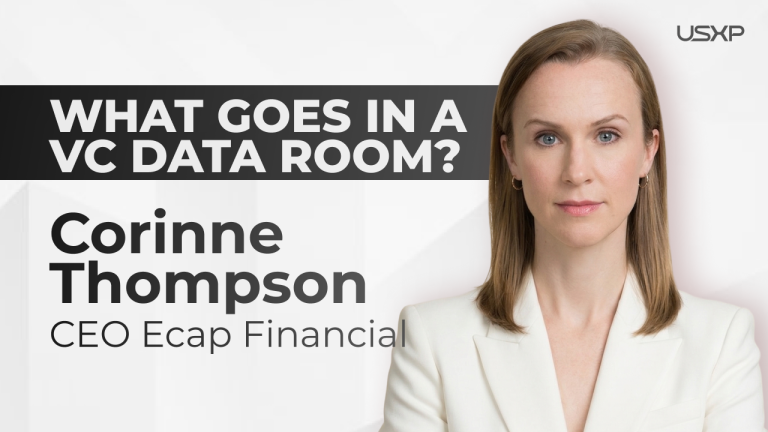

David Rose, CEO of USXP, in conversation with Corinne Thompson, CEO of eCap Financial.
You’ve nailed the pitch. The investor loves the story, the team, and the product. Then they ask for your financial model — and this is your moment to seal the deal.
We sat down with Corinne Thompson, CEO of eCap Financial — a fractional CFO who builds models for fundraising companies and conducts financial due diligence for VC investors — to break down what US VCs want to see, and how European founders can use this step to stand out.
The 3-Step VC Process — And How to Shine at Every Stage
Most US venture deals follow a predictable sequence:
- Step 1 — Screening call: Does your company fit their thesis? Are you a founder they can work with?
- Step 2 — Product deep dive: Demo, discussion, and a closer look at what you’ve built.
- Step 3 — Pro forma review: Show us your financial model.
Step three is where well-prepared European founders differentiate themselves. Understanding exactly what investors are looking for at this stage puts you ahead of most of the field.
Your Pro Forma Is Your Full Operating Plan — Treat It That Way
Many founders assume a budget and a pro forma are the same thing. They’re not, and the distinction matters enormously when raising from US VCs.
A budget is a 12-month operational plan, board-approved and designed to manage the business day-to-day. A VC-ready pro forma is far more comprehensive — your complete operating plan for the business over 3–5 years, built on every material assumption that drives growth: salaries and headcount by role, hire start dates, capital expenditures, cost of customer acquisition, sales team quotas and ramp timelines, marketing spend by channel, gross margin trajectory, and the SaaS metrics that demonstrate how efficiently the business scales.
When done right, an investor can open your pro forma and understand not just where you’re going, but precisely how you plan to get there and what it will cost. A rough P&L or internal budget simply won’t satisfy a US VC — they’re evaluating the depth of your thinking about every dimension of the business.
What a VC-Ready Pro Forma Actually Looks Like
Corinne’s non-negotiables for any investor-facing model:
Structure
- Maximum 6–7 tabs
- Three statements: P&L, balance sheet, and cash flow
- One dedicated assumptions tab
- A summary tab with annualised figures from a monthly base
- Clear formula logic throughout
Summary tab must show
- Top-line ARR growth rates
- Gross profit margins (benchmarked to investor expectations for your sector)
- EBITDA trajectory, headcount, and cash balance at year-end
- Key SaaS metrics
Grouping matters: Don’t export directly from Xero. VCs expect expenses grouped as Sales & Marketing, R&D, and G&A — not a raw chart of accounts.
What US VCs Expect on Revenue Growth
European founders tend to model for profitability. US investors model for growth. Embracing this distinction in your model is one of the clearest signals you understand the US venture market.
Harry Stebbings recently laid out current VC growth expectations for companies at $5M–$15M ARR:
Growth Rate | Likely Outcome |
300%+ YoY | Your pick of investors |
200% YoY | Good — likely Tier 2 investors |
100% YoY | Challenging unless revenue quality is exceptional |
80% or below | Focus on profitability — preserve capital for the right moment |
Demonstrating these rates historically and forecasting them going forward is essential for any European company seeking a US VC. A growth-oriented model is what earns you a seat at the table.
On profitability: Model growth ambitiously, while ensuring the business could reach break-even with minimal adjustments if needed. It demonstrates capital discipline without anchoring your narrative to profitability — exactly the balance US VCs want to see.
The Metrics US VCs Scrutinise
NRR (Net Revenue Retention): Best-in-class is 130%+. Strong NRR signals organic expansion within your customer base — a highly efficient growth engine investors love to see.
Rule of 40: Growth rate + profit margin should exceed 40. A capital efficiency signal that demonstrates responsible scaling, and one UK and European investors pay particular attention to.
ARR per FTE: Increasingly prominent in market analyses. Shows how efficiently your team generates revenue — a key scalability indicator.
For AI companies: Be ready to address how you’re adopting AI internally for efficiency, and how your business is positioned relative to AI disruption in your sector.
What the Investor Sees When They Open Your Model
Because Corinne reviews models from both sides of the table, she knows exactly what creates a strong first impression. Presentation signals quality of thinking before a single number is reviewed — a clean, well-structured model tells an investor they’re working with a founder who is organised and rigorous.
From there, the review follows a consistent order:
- Top-line assumptions — business model, ACV, historical sales attainment, and forward-looking growth assumptions
- ARR waterfall — new business, upsell, expansion, downsell, churn. Every movement needs a narrative.
- Gross margin and unit economics — how scalable is the business?
- Cost assumptions — does the investment required to reach your milestones add up?
- Pipeline (if available) — does the funnel support your top-line projections?
A note on tax and compliance: Deferred tax liabilities and unresolved tax obligations surface regularly in due diligence. Resolving these proactively keeps the investor’s focus on your growth story.
Raising for US Expansion? Model It with Conviction
If your fundraise includes a US expansion plan, granularity builds investor confidence. A single line item reading “US expansion: $1M/year” leaves too much to the imagination.
US investors will want to see:
- Which state(s) you’re entering and why
- Who is going — founder, local hire, or both?
- Realistic US compensation — salaries are higher, with benefits packages that include health insurance, RSU structures, and pension contributions that look very different from UK or EU equivalents
- Travel costs — enterprise sales in the US involves far more relationship-building travel than European markets
- Realistic sales ramp timelines — US enterprise sales is deeply relationship-driven; modelling that reality shows sophistication
- Currency: Build in USD. Convert historical actuals from sterling, then forecast entirely in dollars.
CEOs: This Is Your Model, Not Your CFO’s
It’s natural to delegate the build to your CFO or finance team — and they should absolutely lead the construction. But when you’re in the room with a US VC, every question is coming directly to you.
US VCs expect the CEO to have command of every line. Not a rough familiarity — genuine fluency. The moment you respond with “I’d need to check with my CFO on that,” you’ve signalled that you don’t fully understand your own business. Once your model is built, invest the time to truly own it. Know your key assumptions by heart. Understand how changes in one variable ripple through the rest. Be ready to walk through growth rates, unit economics, burn, and runway in real time, without notes.
Your CFO builds the model. You present it, defend it, and own it completely.
Before You Open a Spreadsheet
Corinne’s advice for any founder about to start this process:
“Get the key people in the room. Whiteboard it out. What have we achieved to date? What milestones do we want to hit? What capital do we need? Get all of that out of people’s heads and onto a whiteboard before you ever put pen to paper on a model or a deck. These two artefacts are just the output of a well thought-through strategy.”
Investors know your three-year assumptions will evolve. What they’re evaluating is whether you understand the business deeply enough to build a rational, compelling picture of where it’s going.
With the right professionals and full data access, a VC-ready model can be built in as little as one week. Build it well before you need it.
The Bottom Line
A VC-ready pro forma is one of the most powerful strategic documents you’ll produce as a founder. Done well, it communicates your complete operating plan, growth assumptions, unit economics, and credibility as a business leader — all in one place.
For UK and EU founders entering the US market, getting this right is a genuine competitive advantage. A well-constructed, growth-oriented model is your clearest signal that you’re ready to compete in it.
USXP helps UK and EU venture-backed tech companies expand into the US market. Corinne Thompson is the CEO and Founder of eCap Financial. Watch for our next conversation with Corinne on due diligence and data rooms.
Ready to build your US expansion plan? Get in touch with USXP.