
Europe is building world-class technology companies. The question founders and investors keep asking is not whether those companies are good enough for the US. It is whether they are ready for it.
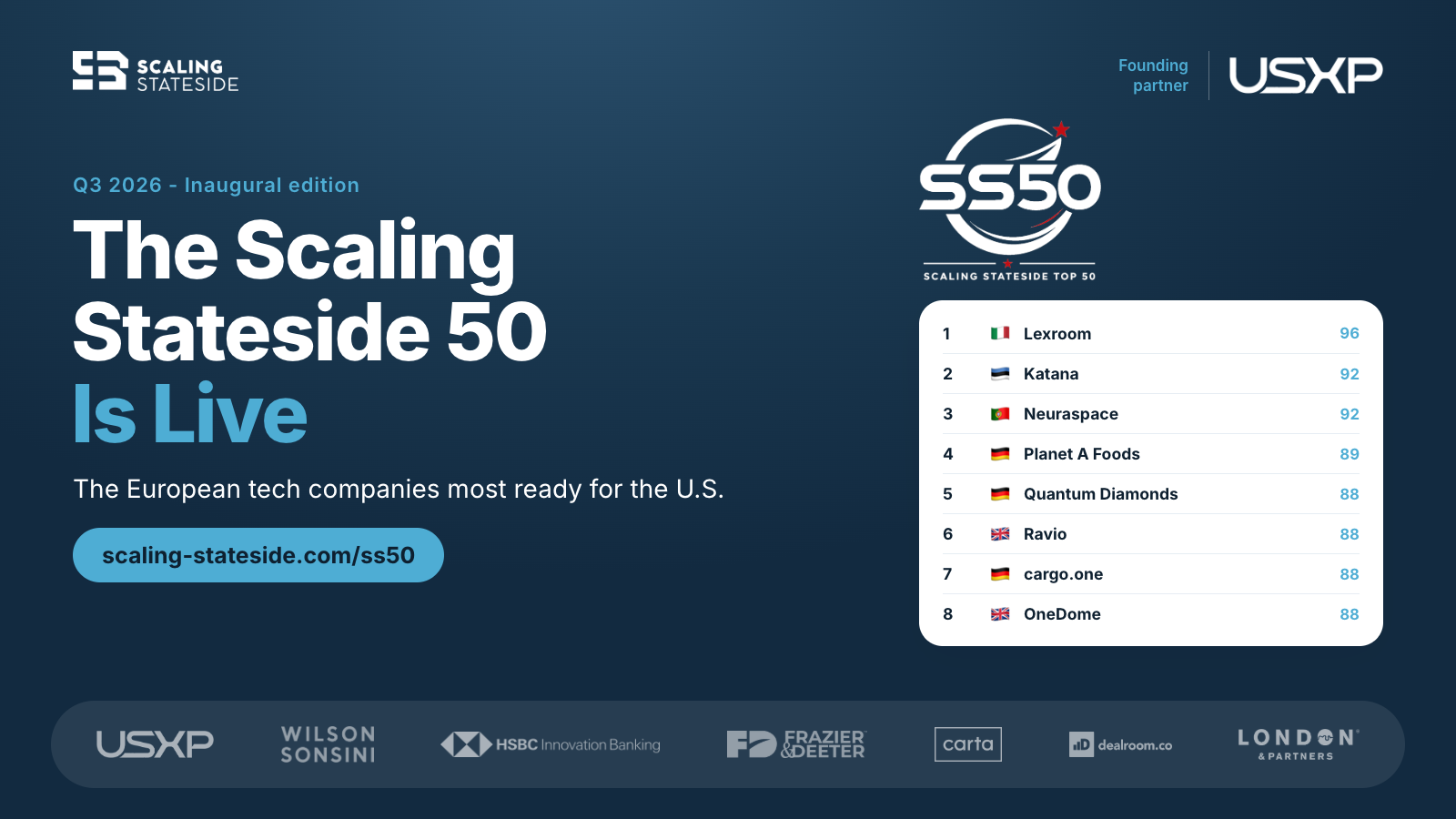
This month, Scaling Stateside, the founder education and US market-entry platform created by USXP and Wilson Sonsini, published an answer: the inaugural Scaling Stateside 50, a quarterly ranking of the venture-backed European tech companies best positioned to expand into the United States.
The Q3 2026 edition ranks 50 companies from 15 countries. Germany and the UK contribute 12 each, France six, and the rest come from across the continent, from Tallinn to Coimbra. Every company is scored with USXP’s US Expansion Readiness Assessment, using publicly available evidence only.
Two scores, never blended
The list rests on one deliberate design choice: commercial strength and US readiness are scored separately and never averaged together.
- Foundation Score (out of 100): How strong is the business itself? Five dimensions: Product, Finance, Marketing, Metrics and Sales.
- US Readiness Score (out of 100): How much US groundwork is done? Six dimensions: US intellectual property, site selection, talent readiness, US operations, go-to-market strategy and US market traction.
Each of the 11 dimensions is scored through a set of yes/no evidence checks rather than a judgment call. A company needs a Foundation Score of 55 or above to qualify, and companies are ranked by Foundation Score. US Readiness only breaks ties.
The result is a ranking of Europe’s strongest businesses, with a clear read on how far each one has traveled toward the US. A single blended number would hide the most useful thing in the data.
86 versus 17
That useful thing is the gap. Companies on the inaugural list average 86 out of 100 on Foundation and 17 out of 100 on US Readiness. Every one of the 50 scored 83 or higher on Foundation. These are proven, well-funded businesses.
Their US-specific build tells a different story:
- 96% have yet to put basic US business infrastructure in place: a US entity, an EIN, US banking or US payroll.
- More than 80% have no US-based employees.
- More than 80% have no US trademark or patent filings.
- 22 of the 50 score 10 or below on US Readiness. Only four score 40 or above.
Lexroom of Milan tops the list with a Foundation Score of 96 and a US Readiness Score of 8. Katana (Tallinn) and Neuraspace (Coimbra) follow, both at 92 on Foundation, with US Readiness Scores of 28 and 12. The pattern also varies by sector: fintech and cybersecurity companies trail SaaS and deeptech in setting up US operations.
What a low US score does, and does not, mean
A strong Foundation Score paired with a low US Readiness Score is the most common profile on the list, and a completely normal one. It says the business is strong and the US-specific groundwork has not been built yet. It is not a verdict on the company, and it is not a prediction.
Because every score is built from public information, it cannot see internal plans. Some companies on the list will have chosen, deliberately, to win at home first. That can be exactly the right call.
Daniel Glazer of Wilson Sonsini draws a useful distinction here. Relocation tends to happen early, when the goal is to win the US market from the start. Expansion is driven by US customer demand after product-market fit. He describes entering the US as an “away match” played under different rules, and advises founders to define the outcome they want, work backward to the resources it requires, and reassess regularly.
Matt Oxley, Co-Founder and President of USXP, built and ran a US business from Portland before co-founding USXP. His view: timing and foundations matter, founders often wish they had moved earlier, and success depends on a strong, locally informed go-to-market function.
Here is what founders need to hear. The US groundwork measured by the US Readiness Score has long lead times. An entity, a bank account, payroll, IP filings and a first US hire do not appear the week a large US customer says yes. Companies that lay that groundwork before they need it are the ones that can move when demand arrives. The 70-point gap between home-market strength and US readiness is not a weakness. It is the clearest map available of where Europe’s best companies can go next.
If you lead one of these companies, or one like them, three questions are worth answering now. Is US demand already showing up in your pipeline, or are you anticipating it? Which of the six US Readiness dimensions would take longest to build if that demand arrived next quarter? And who on your team owns the US plan today? The answers will tell you whether you are on a relocation path, an expansion path or still deciding. Each is a legitimate place to be, as long as it is a choice.
The companies already building stateside
Some companies on the list are well along the path, and the ranking rules make them easy to miss. Because rank follows Foundation Score, two of the most US-ready companies sit at the bottom of the list: poq (London, #49) and Onthos / Theia Insights (Cambridge, #50), with US Readiness Scores of 61 and 58.
Others combine both: Meticulous (London, #19) scores 48 on US Readiness, Quantum Diamonds (Munich area, #5) scores 40, and Planet A Foods (Munich area, #4) scores 39. These are the profiles the rest of the list can build toward.
Evidence, not opinion
The Scaling Stateside 50 is built to be checked. Scores draw only on public sources: company filings, funding announcements, hiring activity, named customers and product releases. No confidential information is used, and nothing in a placement reveals anything that is not already independently discoverable.
To build the inaugural list, USXP generated a Readiness Assessment for every company in the pool. Some completed an assessment directly; others were identified through market monitoring of public signals such as funding raised, growth, hiring and sector fit, and assessed without any prior contact. Companies that cleared the Foundation threshold of 55 qualified, and the 50 highest Foundation Scores made the list.
It is a recognition, not a sales list. Companies cannot pay to appear, there is no cost to being scored or ranked, and a company does not need to be a USXP client to be included. Scaling Stateside’s partners promote the list but play no role in scoring, which is carried out solely using USXP’s Readiness Assessment methodology.
Ranked companies receive their placement, both headline scores and a shareable “Named to The Scaling Stateside 50” badge for their website, LinkedIn or investor materials. Any company can ask to be removed.
What comes next
The list refreshes every quarter. Rankings will move as companies raise, hire, form US entities and win American customers, and from Q1 2027 the list will track progress in US readiness over time. A company that did not make the Top 50 this quarter, particularly one still early in its US build, may well appear once that groundwork is in place.
The Scaling Stateside 50 is published by Scaling Stateside, founded by USXP and Wilson Sonsini, with support from HSBC Innovation Banking, Carta, Frazier & Deeter, Dealroom.co and London & Partners.
See where your company stands
The full ranking, company profiles and methodology are live at scaling-stateside.com/ss50. For the launch coverage, read Tech.eu’s report on the inaugural list.
To see your own Foundation and US Readiness Scores, take the US Expansion Readiness Assessment. It is the same framework behind every score on the list, and it shows you exactly where your US build stands today.