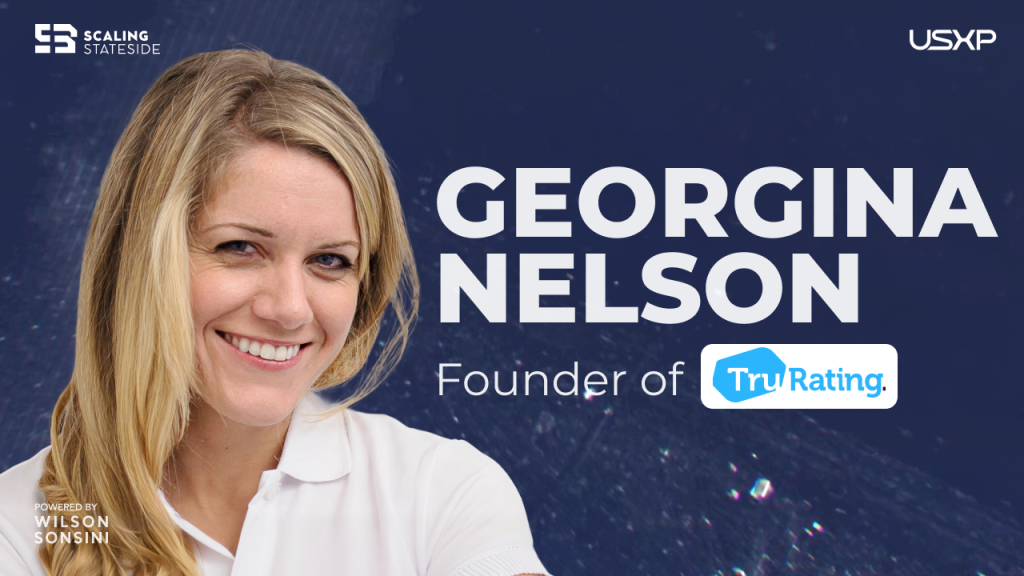
Georgina Nelson’s waters broke while she was interviewing a restaurant manager in London’s Covent Garden. When the hospital told her to come in immediately, she finished the interview first. A few hours after her daughter was born, she bought TruRating.com from her hospital bed.
That same tenacity has carried TruRating from a London startup to a company with more than a billion verified consumer ratings, roughly $40 million raised, and a US business built out of Atlanta. On the latest episode of Scaling Stateside, Georgina joined David Rose and Matt Oxley to share what it took to break into the US market, and what she’d tell European founders considering the same move.
From consumer advocate to founder
Georgina’s path to entrepreneurship ran through psychology, leveraged finance at Clifford Chance, and Which?, the UK consumer organization roughly equivalent to Consumer Reports. Working on big data and privacy there, she saw the edge online giants held over brick-and-mortar retailers. Her father experienced that gap firsthand when he lost half his business to Amazon.
TruRating was built to close it, putting real-time, transaction-level customer feedback into the hands of physical retailers through the payment systems they already use.
Plan for the US before you need it
Georgina’s legal background shaped TruRating’s expansion strategy from the start. She knew the UK was a launchpad, not the destination, so she moved quickly to secure trademarks and patents and to set up companies in both the US and Australia.
Australia became a testing ground. Shorter sales cycles and a smaller market meant TruRating could launch and refine new products quickly. The US was always the main event, with the scale to match the company’s ambitions.
For founders, the lesson is that IP protection and US entity formation are far easier to get right early than to untangle later. USXP’s resource hub covers the entity and structuring questions most European companies face.
Why Atlanta, not New York or Silicon Valley
Many UK companies default to New York because they know it, or to the Bay Area because they assume a tech company has to be there. TruRating chose Atlanta for reasons tied directly to its business model.
As Georgina explained, Atlanta is the epicenter of US payments, with around 70% of card transactions processed there. For a company that depends on payment partnerships, that concentration of expertise and relationships was decisive. Atlanta also offered costs far below Manhattan or the Valley, strong talent from universities like Georgia Tech, a less crowded hiring market, and a business community that actively makes introductions for newcomers.
Her first US hire mattered as much as the city. She met an American at an event in the UK who understood the space, spoke the industry’s language, and brought his own network. He became TruRating’s President of North America. When the team relocated in 2017, they initially moved into his apartment, until a unicorn seat for Georgina’s daughter appeared on his bike and he suggested they find their own place.
The takeaway: choose your US hub based on where your customers, partners, and talent are, not on where other startups go.
Expect euphoria, then silence
One of Georgina’s most practical insights concerns the rhythm of US sales. In early US meetings, prospects are often enthusiastic and ready to move forward. Then they go quiet for months. In the UK, the first meeting tends to be the opposite: the prospect tries to find every hole in the idea as quickly as possible.
In her experience, both markets end up moving at roughly the same pace. The difference is in the signal. Founders who recognize American optimism bias won’t mistake an enthusiastic first meeting for a committed pipeline.
She also describes the UK as a followers market, where buyers want to know which peers in their vertical already use the product. And the US demands architecture built for scale from day one. Some of TruRating’s retail customers operate 7,000 locations.
At-will employment changes how you plan
US hiring cost TruRating about a third more on average than its other markets. Georgina also chose to offer consistent parental leave and notice terms across every market, regardless of local employment law.
That ran into US norms quickly. A one-month notice period means little when American employees typically give two weeks. In the UK, some TruRating team members are on three-month notice periods, which allows a thoughtful handover. In the US, founders should plan for faster transitions with documented processes, cross-trained teams, and an active candidate pipeline. As Matt noted, at-will employment surprises nearly every European founder he speaks with.
Put your culture into words
Keeping one culture across three continents takes deliberate effort. At a Silicon Valley conference, Georgina was told that no CEO could call themselves one without a mantra on the wall. Skeptical, she wrote one on the flight home, and came to value the exercise.
Once culture is captured in words, everything else can be built on it: interview questions that probe a candidate’s grit, resilience, and optimism, and consistent rituals like the Friday recognition sessions TruRating runs across all its markets. She calls it a work in progress, but it has made the company much better at hiring people who share its core values in every location.
Mind the confidence gap
The most candid moment of the conversation came when Georgina recalled a board member telling her to “channel your inner American male.” British founders, she said, instinctively apologize and lay every flaw on the table upfront. US investors and buyers respond to confidence, and money tends to follow it.
She traces the difference back to childhood. At her daughter’s softball games, parents shouted encouragement at every play, while her own father’s sideline advice to her brother was to watch the bloody ball. American schools also reshuffle classmates every year, which builds an ease with new people and new situations. Matt added his own example: US kindergartners pitching in show-and-tell.
Georgina says she is still “pretty female and British,” but the awareness matters. Know what you’re competing against, and get comfortable being more forthright about your strengths.
A $40 million raise, off the traditional path
TruRating never followed the standard route of a UK seed round followed by a Silicon Valley Series A. Its model required building integrations with payment partners before earning any revenue, so capital needs were heavy and early.
The founding team started on sweat equity, then raised from angels whose networks opened doors to family offices and multi-family offices, most of them connected through the UK. Georgina is clear-eyed about the trade-offs. A major US VC brings a network that matters in a relationship-driven market where many deals are still made on the golf course. But not having an aggressive investor focused on short-term sales figures gave TruRating room to navigate tougher periods on its own terms.
Do you need to live in the US to win there?
No, Georgina says. She knows UK-based founders building strong US businesses. But they spend a lot of time on planes. For big contracts, people buy from people, and relationships require face time. Before relocating, she crossed the Atlantic every two weeks.
She has also never met a founder who regretted making the move. Her advice for those who do: treat each state like a different country. Business culture in the Midwest differs from New York, which differs from Florida.
The lesson no playbook teaches
Asked for the hardest lesson she learned, Georgina returned to tenacity. The US is an enormous market, and founders have a finite window to run at it. Her advice is to bring real energy and go after it hard while that window is open.
It’s a fitting close from a founder one board member called “delusionally optimistic,” to which her chairman replied that if she weren’t, none of them would still be there.
Is your company ready for the US?
Georgina’s story shows how much early decisions shape a US expansion, from IP and entity setup to where you land and who you hire first. USXP’s US Expansion Readiness Assessment scores your company across 11 factors and delivers a Foundation Score and a US Readiness Score, so you can see where you stand before you commit.