
The question isn’t whether to enter the US. For most European tech scaleups, that decision is already made. The question is whether you’re actually ready — and the honest answer, for most companies, is not yet.
The US market punishes the underprepared at a speed and a cost that has no equivalent in Europe. A 12-month delay in getting traction doesn’t just burn capital — it hands the market to a competitor, triggers difficult investor conversations, and forces a reset that companies often don’t recover from.
According to Harvard Business Review and Gallup research, 70% of first-time international expansions fail or are delayed by 12 to 24 months. That failure rate is not a product problem. It’s a preparation problem.
The companies that beat the odds don’t move faster. They move better prepared.
The US Is Not Europe, Bigger
The single most common — and most expensive — mistake European founders make is treating the US as a scaled-up version of their home market. It isn’t.
The sales cycles are different. The buyer expectations are different. The way decisions get made, the way compensation works, the legal structures, the employment frameworks — all of it operates differently. Even the way customers want to be talked to is different. US buyers expect direct, ROI-focused communication. They move fast in evaluation and slow in commitment. They respond to social proof and customer references in ways that European buyers don’t.
What works in the UK or EU is a starting point, not a playbook. The companies that succeed in the US spend real time rebuilding their go-to-market for the American buyer before they arrive. The ones that don’t spend their first year wondering why nothing is sticking.
Here is the one number that should drive the strategic decision: for most B2B tech categories, the US represents more than 50% of global total addressable market. If your company isn’t in the US, it is competing for less than half the available prize. The mandate is clear. The question is timing and readiness.
Part 1: Assessment of Current State
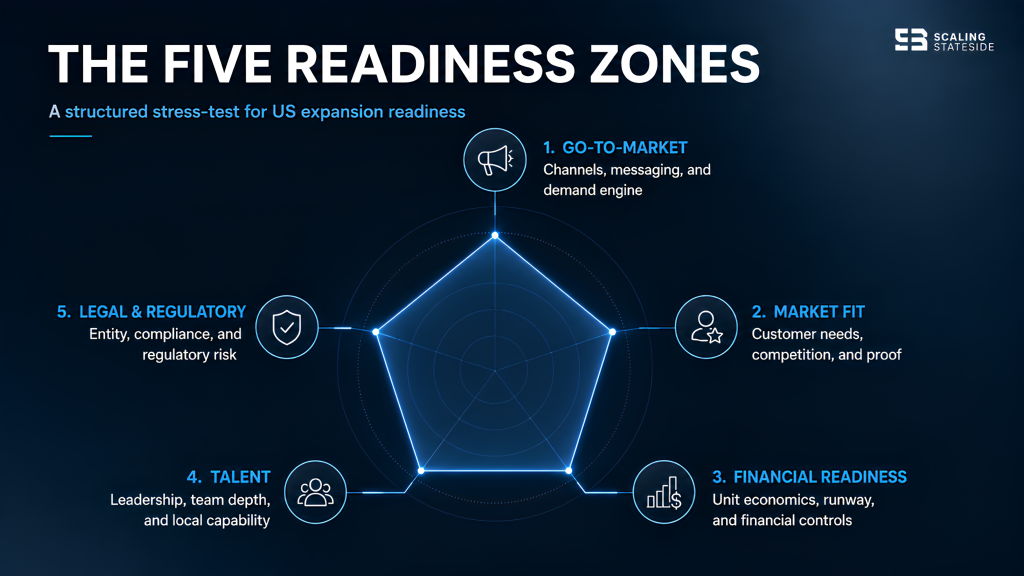
Before any expansion planning begins, there are five fundamental questions every company needs to answer honestly. Not the investor deck version. The real version.
- Does the US represent more than half your total addressable market?
If US TAM sits below 30% of global opportunity, the return on the investment and management attention required for successful expansion deserves serious scrutiny. Above 50%, the US should be the top expansion priority. The TAM analysis should be methodology-driven and validated against competitor revenue data — not assumed.
- Is product-market fit in the home market genuinely solid?
Trying to achieve product-market fit in two markets simultaneously is one of the most reliable ways to fail in both. The home market metrics need to be strong before expansion begins: ARR, 12-month revenue CAGR, sales targets versus actuals, inbound lead velocity, the percentage of reps hitting quota, and net revenue retention. The benchmark that matters most: if net revenue retention is below 110% or quota attainment below 70%, the sales motion is not yet repeatable enough to transplant.
Whatever cracks exist at home, the US will find them — and make them catastrophic.
- Is there capital for two businesses running simultaneously?
US expansion doesn’t pause home market costs — it runs on top of them. The capital requirement is: 18 to 24 months of current home country burn rate, plus a dedicated US expansion budget held separately. That budget typically ranges from $1.5M to $3M in Year 1 depending on location, team size, and go-to-market intensity, with an additional 25 to 30% contingency buffer built in for the cost overruns that are not the exception — they are the rule.
European companies consistently underestimate US operating costs. The geographic location decision alone can create a $250,000+ annual variance. Companies that enter undercapitalized don’t get a second chance at a first impression.
- Are US customers already finding you?
Organic US demand is the strongest available signal of expansion readiness. The indicators to examine: number of US paying customers, US ARR as a percentage of total, the quarter-over-quarter growth rate of US bookings, and the quality and volume of inbound US leads — both direct and partner-sourced. A minimum of 5 to 10 paying US accounts demonstrates repeatability. US revenue above 10% of total ARR signals substantial market pull.
Companies with zero US customers can still succeed, but they require more extensive US market validation before committing capital to a full launch.
- Is there executive depth to run the home business without the founder?
Founder-led US expansion is not optional — it is the only model that works at the early stage. The founder must be in the US, a lot, for an extended period. That creates a critical dependency: home market operations must continue without the founder’s daily presence.
The question every company needs to answer before expansion is approved: who specifically will lead home country operations, with full decision-making authority, while the founder is focused on the US? If that person isn’t on the team today, building that bench is more urgent than any US expansion planning.
Part 2: Preparation for US Expansion
Strong current state scores confirm a company has the foundation to support a parallel market launch. Preparation scores determine whether the company is ready to execute from day one — or whether it is walking into the market with dangerous gaps.
- Has the founder committed to personally leading the US expansion?
US market entry is not operational execution. It is strategic entrepreneurship under unfamiliar conditions. The founder must personally lead because the capabilities required cannot be delegated: pattern recognition from the home market launch, credibility with customers and investors, and the authority to make rapid pivots as market feedback arrives.
Non-delegable founder responsibilities include: identifying US product-market fit through direct customer conversations, making the HQ site selection decision, closing the first 5 to 10 customers personally, building early strategic partnerships, recruiting the first 3 to 5 US employees, and developing relationships with US venture capital firms. If the plan involves hiring a Country Manager on day one and stepping back, the expansion will almost certainly fail.
The founder must commit to 50 to 75% of their time in the US for a minimum of 12 to 18 months. That commitment needs to be visible on the calendar, not just stated in the board deck.
- Has the HQ location decision been made — properly?
“We’ll probably do New York or San Francisco” is not a site selection strategy. It is a default, and defaults are expensive. The location decision has permanent consequences for operating costs, talent access, time zone overlap, and market credibility.
The criteria that drive the right decision: time zone alignment with the home market (Eastern Time provides 3 to 4 hours of daily overlap with UK and EU), operating cost structure, tech sector concentration, depth of available talent in target roles, startup ecosystem maturity, ease of transatlantic travel, and business climate. A company with 5 enterprise sales reps and modest office space will spend approximately $255,000 more per year in New York City than in Research Triangle Park, North Carolina. That differential compounds.
The site selection decision should follow rigorous analysis — not where the CEO wants to spend time, and not the city with the most name recognition.
- Is there a real pro forma model — not an estimate?
The US pro forma model is the operating plan. It is also the first thing any sophisticated US investor will scrutinize. A model built on European cost assumptions or rough estimates will not survive that scrutiny — and worse, it will not survive contact with the actual US market.
A credible pro forma covers: compensation structures benchmarked to the specific target geography, health insurance premiums and employer cost sharing, 401K matching, payroll taxes by jurisdiction, real estate, legal and compliance costs, professional services, travel between the US and home market, and marketing and sales enablement. Revenue projections should include conservative, moderate, and aggressive scenarios with clearly articulated assumptions.
The fundamental sequencing error is building the financial model before completing site selection. Without knowing the operating location, cost assumptions are guesswork — and they are consistently optimistic guesswork. Site selection comes first. The model follows.
- Is the talent infrastructure ready before the first hire?
American candidates — particularly experienced enterprise sales professionals — ask detailed, probing questions during interviews. They operate in an at-will employment environment where employment security depends entirely on the specifics of the arrangement, not statutory protections. Vague or uncertain answers to those questions communicate one thing: this company is not ready for the US market.
Before posting a single job, the following must be in place: compensation benchmarked to market, offer letter templates (not employment contracts), health insurance plan options and premium cost-sharing structure, 401K plan with matching, equity grant structure and vesting schedules, PTO and holiday policies, sales-specific policies including territory assignment and commission timing, HR policies including termination procedures, and a talent vetting process.
Enterprise sales reps take 6 to 9 months to reach full productivity. The wrong hire costs $150,000 to $200,000 in direct compensation plus 6 to 12 months of lost opportunity. Getting this right before recruiting begins is not optional.
- Has the go-to-market been rebuilt for the US buyer?
The European GTM strategy is not ready to copy-paste into the US. The ICP is probably subtly different. The messaging needs to be rebuilt around US communication preferences — direct, ROI-focused, proof-driven. Pricing needs to be validated against US competitive benchmarks. The channel and partner strategy may look completely different. The demand generation mix is different.
A credible US GTM strategy includes: validated ICP definition for the initial 2 to 3 target segments, competitive analysis of direct US competitors, US-specific value proposition and messaging, a defined sales motion (sales-led, product-led, or partner-led), a demand generation plan with US event and content strategy, a sales enablement framework, and a target account list of at least 100 companies with specific buyer contacts.
If the GTM document focuses primarily on tactics rather than strategy, or lacks a clear hypothesis about why the US buyer will respond differently than the home market buyer, the thinking is not yet mature enough to support a launch.
The Most Dangerous Assumption in US Expansion
Confusing ambition with readiness.
The board conversation is energized. The deck is compelling. The investors are aligned. Everyone agrees: it’s time to go to America. And that collective confidence, when it is not grounded in rigorous preparation, is precisely what the 70% failure rate is made of.
The companies that land in the US without a validated pro forma model, a rebuilt GTM, a proper site selection analysis, and a functioning talent infrastructure don’t fail because their product isn’t good enough. They fail because the market moves faster than they can course-correct, the capital burns faster than projected, and the team gets stretched across two continents without enough foundation in either.
Preparation isn’t the exciting part of US expansion. It’s the pro forma and the hiring plan and the site selection analysis and the rebuilt positioning work. It is unglamorous and time-consuming. It is also the difference between a successful US launch and an expensive lesson.
Join Us in London: Scaling Stateside — 18 June 2025
For founders and leadership teams actively evaluating US expansion, USXP and Wilson Sonsini are hosting Scaling Stateside — a live US Expansion Readiness Masterclass in London on 18 June.
The session walks through the complete readiness framework, includes a self-assessment exercise where participants score their own company across all ten dimensions, and closes with a facilitated group discussion with other founders navigating the same decision. This is a working session, not a conference panel — participants are expected to come with real numbers and leave with a clear picture of where they stand and what needs to happen next.
- Date: Thursday, 18 June 2025
- Time: 9:00 – 11:30 am BST
- Location: Wilson Sonsini, London
- Register: scaling-stateside.com/events
This event is made possible through the generous support of our partner Wilson Sonsini — one of the world’s leading technology and life sciences law firms, with deep expertise in helping European companies establish and scale US operations. And our co-sponsors HSBC Innovation Banking and Frazier & Deeter, two of the most active financial partners supporting European tech companies making the move to the US market.