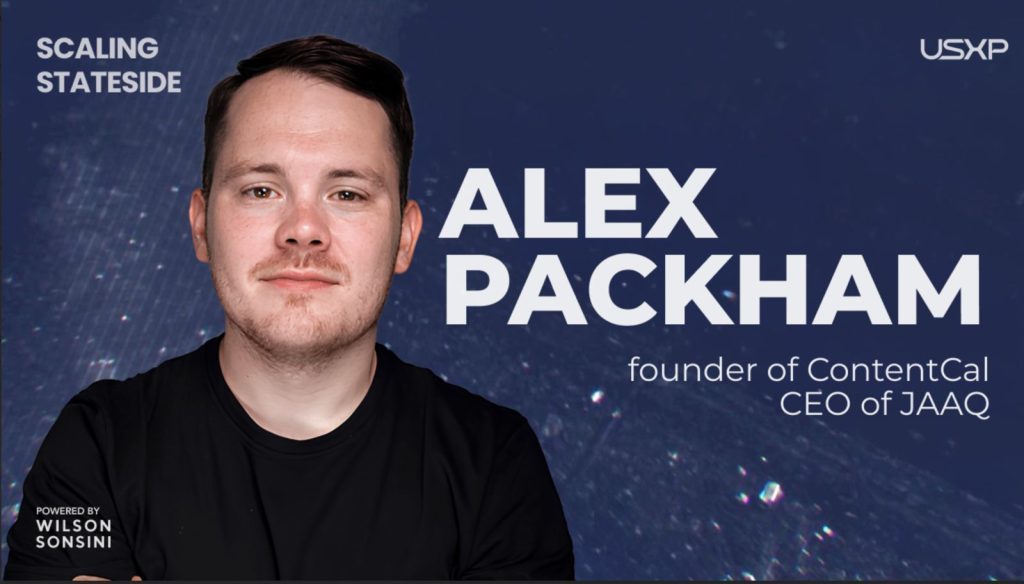
In Episode 8 of Scaling Stateside, Alex Packham shares what three years inside Adobe taught him about how Silicon Valley actually works—and why European founders need to think completely differently about scale.
Key Takeaways
For founders short on time, here’s what Alex learned:
- Silicon Valley’s advantage isn’t capital—it’s execution speed. Adobe teams ask “how do we launch in 5 countries simultaneously?” not “which market should we enter first?”
- Think $100M, not $2M. The investment question isn’t “what can we do?” but “what would make us unbeatable?”
- Culture shock is real. Americans use 25-minute calls, skip small talk, and get straight to business
- Move to the US if you can. Even 2-3 years makes a massive difference (Alex’s biggest regret: not doing this)
- Record-breaking integration. Alex’s team integrated ContentCal into Adobe in 6 months—a company record
Listen time: Full episode is 60 minutes | Read time: 8 minutes
THE CORE INSIGHT
“If I could box that up from a business perspective and put that in everywhere in the world, can you imagine the economic output that would happen? I’m even talking about it thinking I’m so embarrassed I need to move back to Silicon Valley. It’s just the best. It doesn’t exist anywhere else in the world.”
— Alex Packham on Silicon Valley’s execution culture
From Playground Hustler to Adobe Acquisition
Alex Packham’s first business? Selling SIM cards in his school playground for £20 each after finding a loophole in O2’s free SIM card promotion.
“My dream was not to be an astronaut, it was not to be a footballer—it was to be a person in business, be an entrepreneur before I even knew what that word really meant.”
His entrepreneurial DNA came from watching his dad buy and sell on eBay as a kid. While most teenagers were delivering newspapers (which Alex tried and quit after three months), he was already thinking about how to build businesses.
Fast forward two decades: Alex built ContentCal over eight years, raised £10M+, and sold to Adobe in December 2021 when they were a $300 billion market cap company—approximately the 30th largest company in the world.
The sale itself was significant. But what came next changed everything he thought he knew about building technology companies.
Three Years Inside Adobe: The Real Education Begins
Most founders take the money and run. Alex signed a three-year earnout. What seemed like a golden handcuff became “one of the most amazing things I’ve ever done.”
The Mission: Integrate ContentCal into Adobe’s product ecosystem as fast as possible.
The Result: Alex’s team did it in 6 months. A company record.
“We did the integration in like six months, which was like a record for Adobe. And then basically once we’d done what they really wanted us to do, it was like, ‘go and speak to people and find out what else you can do at Adobe.'”
Adobe paid him to figure out what he wanted to do next. For a scrappy startup founder, this was mind-blowing.
What Makes Silicon Valley Different (It’s Not What You Think)
It’s not the money. It’s not the weather. It’s not even the networking.
It’s the execution machine.
“The level of intelligence, technology skill sets, product and product marketing skill sets in California are second to none. They are the best in the world by a country mile.”
The “Appetite to Dominate” That Doesn’t Exist Anywhere Else
Here’s how product planning works in Silicon Valley, according to Alex:
UK/EUROPEAN THINKING: • “Let’s launch in the UK first” • “We’ll see how it goes” • “Maybe expand to Germany next year” • “We have £2M to invest”
SILICON VALLEY THINKING: • “How do we launch in Japan, India, UK, and the US simultaneously?” • “We’ll spend $100M, not $2M” • “I want the best people in the world on this” • “It needs to be done in 6 months” • “We’ll market to 1M customers immediately” • “500K will convert at this ARR level”
“If we’re gonna do something, this is what it’s gonna be, this is researched, this is how it’s gonna look, this is what it’s gonna take to build it, I want the best people in the world to work on this, I want it done in six months, I want it marketed to a million customers within that period.”
The difference? A year later, it’s actually done.
“That only exists there, from my experience. And the ability for that not to be just ‘I want that,’ but a year later, it’s been done. I cannot—if I could box that up from a business perspective and put that in everywhere in the world, can you imagine the economic output that would happen?”
Alex paused, then admitted: “I’m even talking about it thinking I’m so embarrassed I need to move back to Silicon Valley. It’s just the best. It doesn’t exist anywhere else in the world.”
The Cultural Differences No One Tells You About
Beyond grand strategy, Alex noticed everyday differences:
MEETING CULTURE: • 25-minute calls (standard at Adobe) • Skip the small talk • Straight into business • Maybe chitchat at the end
COMMUNICATION STYLE: • More transactional • Less relationship building upfront • Direct and efficient
“Culturally, it’s so funny because the language is shared, but it is a very different way of working.”
These aren’t minor quirks. They’re fundamental differences in how business gets done.
Alex’s Advice: Three Things He’d Tell His Younger Self
- Move to America (His Biggest Regret)
“If you’re young enough, free enough and have the appetite, go and move to America. It doesn’t have to be forever, but go there for two, three, four years and go and experience it because just the opportunity there is enormous.”
Why? The capital is unmatched. The opportunity is unmatched. The learning is unmatched.
Alex’s admission: “I didn’t do that and I so wish I did. I’m not dead yet so maybe that will happen.”
- Just Go for It (You’ll Figure It Out)
“I didn’t know what I was doing for 10 years. I learned an awful lot over that 10-year period and I accumulated learnings and knowledge. But when I was 23 and I started out, I didn’t know anything about anything in reality.”
The lesson: Passion + drive + willingness to learn is better than having all the answers upfront.
If you’ve stress-tested your idea and have the energy—go for it. It’s one of the most satisfying journeys you’ll ever go on.
- Be Serious, But Don’t Lose Yourself
This one’s different. It’s not advice Alex followed—it’s what he wishes he’d done differently.
“I took my business journey like it was life or death, like it was serious. I wish I sprinkled a little bit more enjoyment, shall we say, and softness into that journey.”
Why it matters: “I was almost like a performance of myself for 10 years in that capacity, if you know what I mean, and kind of reduced some of my normal personality, which has come out later in life weirdly.”
The better approach: “Do it, be serious, but try and enjoy it even on the bad days and bring yourself to it. That’s the main thing.”
Success doesn’t require sacrificing your authentic self. In fact, bringing your whole personality might make the journey more sustainable.
What Alex Is Building Next
After three years at Adobe, Alex is now CEO of JAAQ, his latest venture. He’s also an active angel investor in approximately 60 companies, advising founders navigating the challenges he’s lived through.
His unique perspective spans: bootstrapped beginnings, venture scaling, operating inside a $20B revenue global company, and navigating an exit and earnout.
The Bottom Line for European Founders
You don’t need to move to Silicon Valley to build a globally competitive company, raise US capital, or sell to an American acquirer.
But you do need to understand:
- How Americans think about scale – $100M questions, not $2M questions
- How they execute – months, not years from strategy to delivery
- How they work – 25-minute calls, minimal small talk, straight to business
- What they expect – world-class talent, multi-market launches, aggressive timelines
Alex built ContentCal in London and sold it to Adobe without relocating. But his three years inside Adobe gave him something more valuable than the acquisition proceeds: understanding what makes Silicon Valley’s machine work.
The opportunity to build globally competitive companies from anywhere has never been greater.
But only if you’re willing to think, act, and execute at Silicon Valley’s pace—even if you never leave London.
Quick Action Summary
If you’re a European founder planning US expansion:
- Ask yourself: “What would we build with $100M instead of $2M?” • Change your timeline: Months to launch, not years • Recruit globally: Best in the world, not best available locally • Plan multi-market: How do we launch in 5 countries simultaneously? • Adapt communication: 25-min calls, less small talk, straight to business
The Scaling Stateside podcast is powered by Wilson Sonsini. Wilson Sonsini provides legal counsel for technology companies and growth enterprises.
About Scaling Stateside
Scaling Stateside brings you candid conversations with European founders and investors who have successfully navigated US market expansion. Hosted by David Rose and Matt Oxley from US Expansion Partners, each episode dives deep into the real challenges, hard decisions, and practical strategies that actually work when building across the Atlantic.
New episodes drop twice monthly. Subscribe on your preferred podcast platform to join the conversation.