If more than 50% of your total addressable market sits in the US, or your US TAM alone clears $1 billion, the strategic question has already been answered. You need to win US market share. That’s not a someday goal. It’s the market you’re building a company to serve.
The harder question, the one that actually determines whether you succeed, is timing. When do you move from “the US matters” to “we are actively investing in the US”? Jump too early and you burn capital chasing a market that isn’t pulling yet. Wait too long and a better-funded competitor claims the ground while you’re still debating.
This is where demand signals come in. They won’t tell you whether the US matters. Your TAM already answered that. What they tell you is when the market is ready for you to show up in force.
Why Founders Mix Up “Whether” and “When”
It’s a common pattern: a founder spends a board meeting debating whether the company should prioritize the US, when the TAM math already settled that question months ago. The real conversation that’s missing is about readiness. Should the team hire a US-based salesperson this quarter? Open a US entity now or wait two more quarters? Redirect marketing spend toward US channels, or keep building the home market first?
Those are timing decisions, and timing decisions need evidence, not conviction alone. That’s exactly what the six signals below are built to provide: a way to separate genuine market pull from wishful thinking, using data most teams already have sitting in their CRM and finance systems.
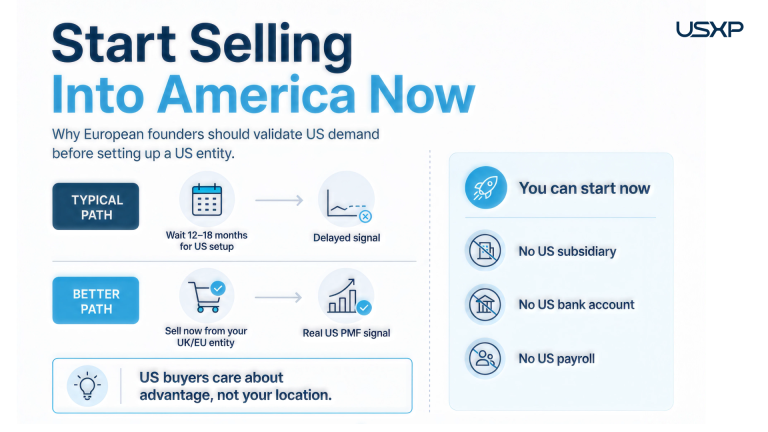
Worth noting: you don’t need a US entity in place to start generating these signals. In Start Selling Into America Now, we covered why founders can begin selling directly into the US from their existing UK or EU entity, long before any legal structure is set up. The signals below are exactly what that early, founder-led testing produces. Tracking them is how you know that early activity is turning into real momentum.
Six Signals Worth Tracking
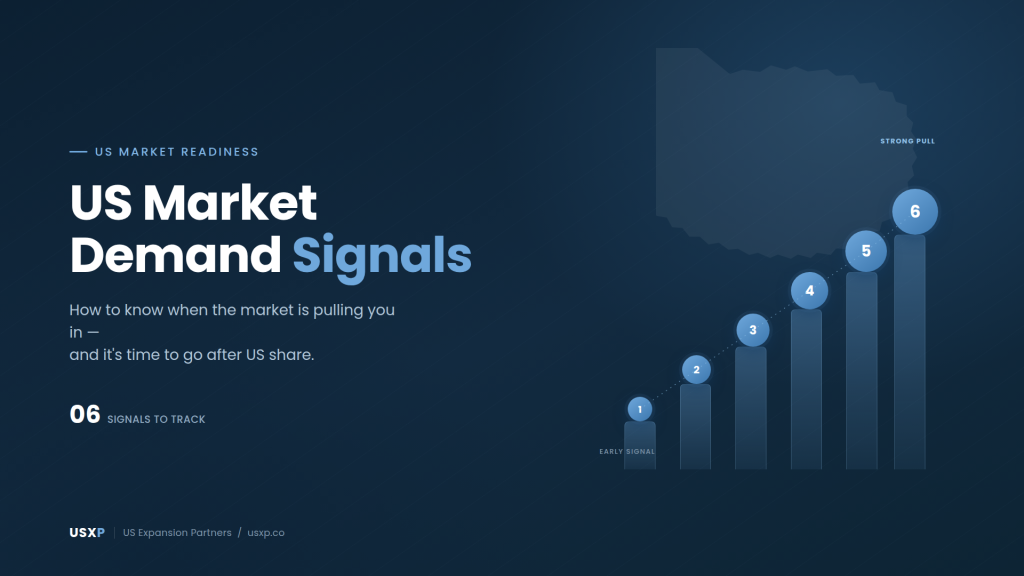
USXP works with UK and EU founders on a structured readiness assessment before they commit real resources to a US launch. Six signals consistently separate teams that are early-but-not-ready from teams that are genuinely being pulled into the market. None of them is decisive on its own. Together, on a rising trend, they tell a clear story.
1. Number of US Paying Customers
Start with a simple count: how many paying customers do you have with a US billing address or US-based buying decision today? A handful of logos won by an unusually persistent sales rep is different from a pattern of inbound US customers finding and buying the product with minimal friction. The second version is a signal worth acting on.
Pay attention to how those customers found you. If most came through cold outbound effort, the market hasn’t found you yet. If they came through search, referral, or word of mouth, the market already has.
2. US Revenue
Customer count tells you where demand is coming from. Revenue tells you how much it’s worth. Track US revenue as its own line, separate from EMEA or global totals. Even a modest absolute number is meaningful if it’s growing steadily and generating itself without a dedicated US team behind it.
Set a simple internal benchmark, such as US revenue reaching a specific multiple of your average deal size, and revisit it every quarter rather than waiting for an arbitrary milestone to feel obvious.
3. Percentage of Overall Revenue from the US
This is a proportional view of the same data, and it matters because it shows you where the center of gravity is shifting. A company earning 10% of revenue from the US with no local team is a very different story than a company earning 10% with three years of steady sales investment already in the market. Watch the trend line, not the single data point.
4. Velocity of US Revenue
Growth rate matters more than the current total. A market that’s compounding, even from a small base, is telling you something the raw dollar figure can’t. If US revenue is growing faster than revenue in your home market, that’s a strong early indicator that demand is outrunning your current level of investment.
5. US Inbound Direct Leads
Inbound is the market raising its hand. Track the volume and quality of leads coming directly from US-based prospects, through your website, product-led growth motion, or organic discovery, without your team prospecting for them. A steady rise here usually means US buyers already know your category and are actively looking for a solution like yours.
Segment these leads from the rest of your pipeline in your CRM so the trend is visible on its own, rather than blended into a global total where it’s easy to miss.
6. US Inbound Partner Leads
The final signal comes through your ecosystem rather than directly. Are US-based partners, resellers, integrators, or referral sources starting to bring you US opportunities without being asked? Partner-sourced demand is often one of the most reliable early indicators, because it means the market’s existing players already see you as relevant.
If US partners are proactively asking how to sell your product, that’s a stronger signal than almost anything you could generate through your own outbound efforts.
Two Common Mistakes to Avoid
The first mistake is acting on a single strong quarter. A spike in US revenue driven by one large deal isn’t the same as a trend across all six signals. Give yourself at least two or three consecutive quarters of consistent movement before treating it as a real pattern.
The second mistake is waiting for certainty that will never arrive. Founders who wait for all six signals to be unambiguous often watch a faster-moving competitor establish the relationships and brand presence they were hoping to build. Directional evidence across several signals is enough to justify a measured next step, even if the picture isn’t complete.
Reading the Signals Together
No single signal should trigger a go/no-go decision. The value is in watching all six move in the same direction over consecutive quarters. Rising customer count, growing revenue, an increasing share of overall revenue, accelerating velocity, and inbound demand building from both direct and partner channels together describe a market that is actively pulling you in, not one you’re pushing into.
This is also why the signals matter more for timing than for strategy. If your TAM analysis already told you the US is essential, these signals exist to answer a narrower, more practical question: is now the moment to build a real US go-to-market motion, or is there more room to let organic demand develop first?
Turning Signals Into a Decision
The most effective founders we work with don’t wait for all six signals to be flashing green before they act, and they don’t wait for perfect certainty either. They build a simple quarterly dashboard, track the trend across all six signals, and use rising momentum as the trigger to shift from opportunistic US sales to a deliberate, resourced expansion plan.
Momentum on these signals is the market telling you it’s ready for you. The question worth asking every quarter isn’t whether the US matters. It’s whether the US is ready for you to show up in force, and whether you’re paying close enough attention to notice.
And if you haven’t started generating any of these signals yet, that’s the place to begin. Our earlier post, Start Selling Into America Now, walks through exactly how to make your first US sales before you’ve set up a US entity.